Marion Brothers

Marion Brothers
Showing posts sorted by relevance for query Shaquanda Cotton. Sort by date Show all posts

Saturday, April 7, 2007

Proposing the Initiation of Black Accused Support Groups (BASG's) within the Afrosphere

.
By the Francis L. Holland Blog.

Photo Sharing and Video Hosting at Photobucket

This essay, inspired by Exodos Mentality and Field Negro and Shaquanda Cotton, proposes that one fundamental endeavor of the new Afrosphere should be supporting the initiation of a national union of independent Black Accused Support Group blogs (BASG's) that are members of an international Afrosphere Black Accused Support Coalition (BASC).

The successful recent Afrosphere advocacy for Shaquanda Cotton brought to our attention the fact that at least 550 other Texas teenagers should immediately be released from Texas correctional facilities, because they were being held beyond the end of the minimum sentences imposed by the sentencing judges, with the effect of protecting the jobs of the same functionaries who extended the children’s sentences. The international advocacy for Shaquanda Cotton forcefully reminded us of the literally hundreds of thousands of other Black accuseds in need of immediate advocacy.
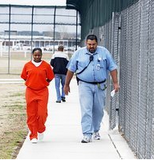
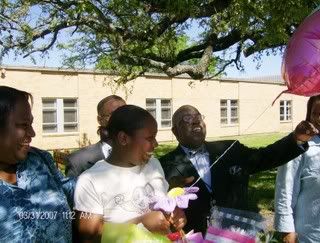
Photo Sharing and Video Hosting at PhotobucketPhoto Sharing and Video Hosting at Photobucket

No one group can give the individualized attention to all of these cases that the Shaquanda Cotton case received. But, any Black person who knows (or is herself/himself) a Black person who has been wrongly accused or unjustly sentenced can start a blog relating the facts of the case, for the purpose of building support for justice for the accused(s). This is what brought the freedom of Shaquanda Cotton, as the result of the immensely successful Shaquanda Cotton blog did.

The newly-won freedom Shaquanda Cotton is a victory that can and should be replicated nationally and internationally, through the initiation of hundreds or thousands more Black Accused Support Group blogs (BASG’s), united within the Afrosphere’s Black Accused Support Coalition (BASC).

Shaquanda is Free, With 550 More Texas Teenagers to Be Released http://francislholland.blogspot.com/2007/04/550-more-texas-teenagers-to-be-released.html

Precisely because there are so many Black people in America who are accused of crimes, in prison or at risk of being sent back to prison in (on parole or on probation), or culpable but experiencing cruel and unusual prison conditions, there exists an enormous opportunity for organizing Black communities to work for liberty and justice for our jeopardized community members.

It costs about $50,000 dollars per year (?) to keep a Black man or woman in prison – an amount that could easily support a whole family if used to offer a job instead of imprisonment.

The way to start a local Black Accused Support Group (BASG) within the Afrosphere is to start a Black blog that tells the history of one or more accused Black people. Include within that blog a “Welcome to the Afrosphere” list of Afrosphere blogs, using the AfroSpear icon in the Blog layout to identify this blog as part of the Afrosphere and part of the International Black Accused Support Group Coalition. Advocates who do not know how to start a blog can request help from any member of the Afrosphere and receive immediate assistance and directions for starting a BASG blog.

The issues raised and advocacy raised in these independent BASC blogs will likely receive spontaneous or organized support in the Afrosphere consistent with the compelling nature of the case and the effectiveness of the presentation made in the BASC blog.

Because Afrosphere blogs are independent and spontaneously organized, all Black people have an opportunity to present their case to the nation that there is a Black person wrongly accused or unjustly sentenced.

The BASG’s can be another way to help stop urban violence, uniting the families of warring factions behind the common goal of freeing those community members who have been imprisoned and preventing others who are currently defendants from receiving unjust and excessive convictions and sentences. BASG can advocate for increased funding for alternative sentencing modalities, like drug and alcohol treatment and accused participation in BASG support groups.Can the Afrosphere Help Reduce Urban Violence?

About these above ideas, Eddie Griffin, ex-Black Panther now working in Texas on the correctional issue, says,

Dear Francis, In all of my years in the struggle, there are few people with as much creativity as you for insight. You have created a very powerful voice in the black community across the United States and growing around the world. My individual network has a little more than 700 people and an upload of at least 10,000 worldwide.

I was pleased to see the Internet take up the case of Shaquanda Cotton because it opened the way for the other 550 kids trapped in the system. With the light on Cotton, the other TYC scandal story, which the mass media was trying to suppress, came out in the open.

This will be a major story for some time to come. I am in a position to ride the helm on this. I am directly involved with Texas legislators working on the TYC problem. I'm glad you guys picked up on the fact that Shaquanda was not the only black youth to suffer injustice and abuse.

Sincerely,
Eddie Griffin


As proposed, BASG blogs will all be independent but interlinked and will build the movement for justice for Black people within American legal system.

If there's anything Black people have in common in America, it's that we are all concerned about someone who is accused, incarcerated, on probation or parole, and who has, in many case, lost the right to vote to change the system.

When Black blogs united to successfully achieve the release of Shaquanda Cotton, we discovered that there were at least 550 other mostly minority youths in the Texas correctional system whose sentences had already expired and who were being unjustly detained.

We need to encourage the mothers, sisters, brothers, wives, husbands and friends of accused Blacks to (1) start blogs on behalf of the accused, and (2) link those blogs with others to develop the power to release those who are being unjustly held, and to prevent the imprisonment of those who are, or may in the future be, unjustly accused.

I have been thinking about this idea for a while as a way of organizing and radicalizing Black people in the United States to come out of our slumber and defend ourselves. Any one of us could be Shaquanda Cotton tomorrow, and the organization we build today may save our lives next week.


Tuesday, April 24, 2007

UPDATE: Shaquanda Cotton: Youngest Political Prisoner & Civil Rights Hero

Monday, April 23, 2007

Excuse me, if I offend you with this Declaration that Shaquanda Cotton is the youngest political prisoner recently released from the corrupt Texas Youth Commission (TYC). People have called into question the entire Texas Juvenile Justice System, accusing it of racist disparity in the administration of punishment. The story of Shaquanda Cotton is a case example.

She wrote a letter from the Brownwood Juvenile facility where she was incarcerated. She broke through very heavy censorship, in a corrupt system where children are held incommunicado, who are abused and violated behind the walls of incarceration, at the end of the line of the justice system. If they even so much as complain about their condition, the letter will not make it outside the walls.

How do I know? My name is Eddie Griffin, a former U. S. political prison, recognized worldwide in 1977. The government purposely held me incommunicado to silence my writings from a prison cell. Shaquanda Cotton, for a 15-year old, wrote the letter of her life, and it broke open the gates of hell, known as TYC.

I was compelled to see Sequanda Cotton in person, the Paris teenager locked up in a Texas Youth Commission (TYC) detention facility for shoving a hall monitor at school. I had to see for myself if the child was all right after the trauma of being incarcerated for a year. I was determined to be there on Sunday, April 22 at the New Salem Missionary Baptist Church where a rally was held in her honor.

When I started out for the small northeastern Texas town, I had absolutely no idea where I was going. I crept around winding back roads, through rural wooded farmland and sparsely populated communities, and no map for guidance. Of the thousand reasons to turn back toward Fort Worth, I was driven all the more by faith that I would get a chance to see this young lady that I had written so many stories about. Shaquanda Cotton had become a folk hero of sorts and crowned the youngest civil rights hero for a letter that squeezed through the crack of censorship and made it to the outside world and provoked outrage around the world. I felt that this was my child, who had finally been set free by public protests, radio talk show publicity, and a massive online campaign.

Getting lost going to Paris, Texas was only a calculated risk for me. Still there was something I wanted to see in her eyes. Was she like other young girls her age, who, a year before, popped bubble gum, jumped rope, and painted her toenails like grownups? Or, was she the wayward child the prosecutor and judge described before they sent her up the river for possibly seven years? I agonized over what I might find and the sacrifice I was willing to make in order to find it.

How was Shaquanda Cotton doing since being released? How had incarceration affected her life? Were she and her mother planning to stay in Paris, after the controversy of racial injustice had brought notoriety and shame upon the city? People around the country and around the world wanted to hear her voice, her own words, not mine.

At last, I arrived in Paris. Making it back, however, would be another question. For the moment, I could have cared less. A kind local resident went out of his way to escort me the last mile of the way to the church on Hickory Street where the rally was already in high session. There was standing room only for the overflow crowd.

Ron Muhammad, a member of the Million More Movement who recognized me, brought me to a seat on the front row, beside some of the dignitaries and preachers. But I had not come to stand before the podium and make a speech and heap fiery coals of condemnation up the city. There were enough ministers to preach about black people’s indignities. Neither was I there to have my voice heard from the audience. I had come, only in hopes of spending some private quality time with Shaquanda and her mother, which was arranged by Bryan Muhammad, one of the leaders of the coalition on the ground. To savor the moment, I took a picture with mother and daughter.

On the program were young hip-hop artists rapping about God and giving praise to Jesus. One teen brought the audience to its feet with her rendition of “Lean on Me”. “We all need somebody to lean on”, the singer sang, paying individual tribute to all the supporters, whom Shaquanda called upon in her legal distresses. And, there was civil rights lawyer Bobbie Edmonds there to give legal guidance and advice to Paris residents who had no one else to lean on.

During much of the four-hour rally, young Shaquanda stared blankly out into the audience. One minute she was there, the next she was out in space, peering into another dimension with a glazed look in her eyes. She was still in a dream state like the child that wished upon a star- the North Star that led slaves to freedom. Her dream had come true. Her prayers had been answered. And yet, it seemed, that it had not completely registered in her mind, that she was actually free.

Such a moment should have had her beaming from ear to ear with joy and happiness. But the glazed stare I had seen before, in the mirror, some 23 years ago. We call it the “penitentiary stare”. It only comes from being institutionalized over a period of time. I called this to the attention of her mother Creola.

“She’s not the same child, is she?” I casually asked.

Her mother shook her head. “She’s changed a lot.”

Poor child, I thought, forced to grow up before her time. I knew that incarceration caused men to go into “a fog” upon being released. But I was surprised to see it in the eyes of a child- that far away look where deep pensive thoughts take shape and etches a hard look upon the face of the institutionalized. This is the look of a person who has faced dangers and hostilities every day while in custody- a kind of unperturbed façade that masked a person’s fears and anxieties. I could not help but wonder: What have they done to my child? They robbed her of her childhood.

Everybody else probably saw it, but ignored it. The rally was designed to make Baby Cotton feel uplifted and happy to be free. In their fixation, they may have painted an imaginary smile upon her face. But I knew what Shaquanda knew. She was still not free because she was living too close to her immediate past memories- the hostilities, arguments, and fights in prison. Leaving that environment did not automatically leave the images behind. The ghost of TYC was still alive in her mind. It was a secret. Together, the three of us laughed it off- at least, for the time being. The hard days are yet to come. Nevertheless, when it was her time to speak, she took heartening courage.

“It was traumatic,” Cotton said of her 12-month stay in the Brownwood facility, where she said she witnessed kids fighting and listened to threats. “I didn’t go through stuff like that because I stayed in my room.”

Relationships there were pitiful, Shaquanda said.

“I missed my family,” she said. “My father died two weeks before I was released, and I was unable go to his funeral.”

The teenager appealed to other youth and said being locked up is not a way to spend life.

“We need to stop fighting against each other and take a look at the things that are going on around us and stand up for ourselves,” Shaquanda said. “Don’t let anybody tell you that you can’t be anything, because I have been told that many times.” (“Cotton speaks on TYC stay”, Mary Madewell, The Paris News, 04/23/07)

When she said that she had lost her father, it reminded me that lost both my grandparents during the time of my incarceration between 1972 and 1984. After my return home, my mother told me how each grandparent had waited and waited, just to see my face again before they died. But they never did. It is still the lost chapter in the book of my life. It will forever be a lost chapter in Shaquanda’s life.

But life goes on. The assault case against the juvenile did not go away. It is now on appeal, and no one is talking, because of the age of the child. Such information must be kept confidential. And yet, under the cloak of confidentiality, there is another side of the story being kept suppressed. She alluded to her treatment inside TYC. Instead of bemoaning how she was written up for an extra pair of socks in lockup, she seemed to have suddenly realized that such petty disciplinary was no longer important. She waved it off by the wave of a hand as if to wipe the slate clean and then added, “That’s a whole ‘nother story.”

Of course, there is another story for another day. But there is also another story for today, and that is the story of Paris, Texas and allegations of racism. Before the Chicago Tribune story was published and the case of Shaquanda Cotton brought to national attention, few African-Americans in this community of 25,000 people had ever heard of the youth. And, the only source of information Paris residents had after the story went public was through The Paris News, which other blacks concede never publish the whole story. Most of the published letters to the newspaper’s editor condemns the youth and tries to hold her responsible for actions she still disputes. There were letters defending the Paris Independent School Districts for its action to criminalize the child. There were letters supporting the decision of the judge to throw the book at her.

Secretly, blacks in Paris speak in hush tones about racism. They suspect it. But they are not given enough information to actually see the disparity in justice. On this one thing, however, they all agree. Shaquanda Cotton should have never been sent to prison. The judge and prosecutor fault the mother for not accepting a probation offer, but they, themselves, will never admit the fact that they pursued the wrong course of action in this case.

On the way out of the city, I caught a black man and a black woman alone at a service station. I asked them privately about the Cotton case. They admitted that they did not know what to think. This is when I realized that the rest of the world knew more about the Shaquanda Cotton case, from outside news sources, than the people who actually live inside of Paris.

QUESTION: Are there Political Prisoners in the United States?

UPDATE: Shaquanda Cotton Story makes international PanAfrican News

Monday, April 16, 2007

The End of the Line

Black Youth like Shaquanda Cotton:
Clueless of the hell that awaits them inside prison


4/16/2007 9:31 AM

[Don’t even go there]

The last place on earth anyone would want to be is in prison. It’s not what you think even in your wildest imagination. But not all prisons are alike. When they send a man down the river from one tough penitentiary to one tougher than the others before it, you began to realize it's all downhill when you meet a different class of characters- lifers with nothing to lose. The toughest of the tough pens is where the government cares less if a person lives or dies. They would rather not put them back on the streets alive. For them, there is a special prison. It’s the End of the Line.

As I write, there are hundreds of young people being released from juvenile detention in the Texas Youth Commission (TYC) system. Among them was a 15-year old named Shaquanda Cotton from Paris, Texas. Straight from high school, in her freshman year, she was sent to prison, for up to her 21st birthday. For good behavior and cooperation, she could have been released in a year. But it took a scandal and a series of protests to free her, after her prison time was extended by a minor disciplinary infraction- possession of contraband, to wit an extra pair of socks.

I’ve seen it before, so many times. I remember being written up for a prison disciplinary infraction, to wit possession of a knife. The report did not say it was a peanut butter knife. They set off my parole date by two years. And, every time I went before review the knife would come up as an issue to deny me freedom. In the privacy of my cell, I cried. They did me wrong.

So, I can empathize with Shaquanda Cotton, sent to prison for shoving a school hall monitor. Nobody believed her side of the story- that she was pushed first- except her mother. If it were not one thing, it was another. Her daughter was constantly being written up for infractions in school.

The funny thing about infractions is their capriciousness. I was written up once for an “insolent stare”, because I was looking a prison guard funny (like a man with murder in his eyes). They took some of my good time and lengthened my stay in prison.

In an enclosed system, like the prison system, cases on the inside usually never see the light of day. There is a curtain of brick and steel, where out of sight means out of mind. So it seems normal for people on the outside world to ignore petty complaints from those confined. After all, who would even give second thought to a prisoner being clubbed over the head by a prison guard? The thinking usually goes: Because he is in prison, he probably deserves clubbing over the head. Prison officials usually feed off this silent consent and take it as a blank check to straighten out convicts by any means necessary. Framing a prisoner up to get more time is not unethical when they don’t want you to go home again.

I was so ashamed that prison officials charged me with making a sexual gesture toward a female guard. My locker had been burglarized by another inmate. When I reported to the guard, she asked for the two pieces of my lock as evidence, so she could write a report. When I put the male end of the lock into the female end, she called it a “sexual gesture”. I was sent to solitary confinement and, again, good time was taken, and my sentence lengthened. In the privacy of my solitary cell, I cried because they had framed me. But whom could I tell?

I didn’t consider myself a crybaby in prison, and no one else did. But some injustice hurts so bad, a person just cannot stop the tears from coming. Next comes rage.

The problem with rage is that the person enraged often suppresses it. I took my rage out on paper. That’s how I became a writer, a jailhouse lawyer, and an advocate of the oppressed.

There are children in school who are suppressing their rage, mostly due from some perceived or real injustice. The approach to these angry youth has usually been zero tolerance, as oppose to channeling all that energy into constructive avenues. It beats me how a schoolteacher can send a child straight to prison. Hopefully, the Texas legislature will put a stop to this direct railroad line to prison for school age youth.

The object is to save as many children as possible. The recent release of some 400 youth from TYC is a good start. But for many releasees, it may be the start of a downward spiral, becoming frustrated at new obstacles, scaling down their own life expectation, overcoming a time gap, and trying to live in a non-combat zone with a combat mentality. (All prisons are combat zones. Fighting and killing is part of prison life.)

In a piece entitled “anger management” for ex-offenders, I took a different approach to the self-guilt trip of accepting some perceived "responsibility" to a more objectivist approach. The rationale to this approach deals with the realization that anger is justified in some cases, as in the cases of injustice. Accepting guilt for an injustice is an internal contradiction. A person cannot get me to accept guilt for “insolent stares”, although it was a penitentiary infraction, its interpretation was purely in the mind of the observer. It requires reading intent behind my eyes, something no man can do.

Angry people look angry, and some people care less about pacifying their anger. Hard-nose convicts in the toughest prison love to play mind games to see who can play whom “out of pocket”. If they can provoke another man to anger or fear, they can set the stage for a showdown. And, nobody gets through prison without a showdown. Everything is geared for the face-to-face showdowns that will surely come. It is the only way a person can earn a place in prison society. And, climbing the hierarchy ladder to earn the reputation of being the toughest guy in prison means going down the line, until a man reaches the end of the line. And,no man cheats death.
But sometimes in my post-release days, I fell that I actually did- cheat death.

I am thankful, therefore, that Shaquanda Cotton has promised to make a new start and be “a better person”. I would hope that the rest of the youth do likewise. But being a better person means more than wishing to be a better person. It takes faith. In Shaquanda’s case, it will take faith and healing.

Here, again, healing is a stumbling block, especially in a society that prefers to aggravate the wound. An ex-offender has to endure prejudices. Even with a sanitized prison record, Shaquanda will face prejudices and discrimination. First, there were those who were opposed to her being released. Second, after the City of Paris became scandalized with allegations of racism, some do not want her to return to her home community. There was no grand “Welcome Home” for the youngest civil rights hero. And, third, wherever she goes, whether to college or into the employment world, somebody is always going to say, “Aren’t you that girl?”

Whether Shaquanda Cotton is broken or healed, she will still have to deal with it. In the lonely hours, where there are no witnesses, and no one to blame, she will have to suck it up and move on. She has not been to the end of the line, as I have. Juvenile detention is just a start of a long downward fall. There are worse places, and worse places than those. Some people call prison “hell on earth”, but if you haven’t been there, you have absolutely no idea how true this is until you sink to the bottom of society, where no one cares if you live or die.

One of the biggest secrets in the prison system is the statistics on how many prisoners die from being beaten and stabbed to death. The public would be horrified. Where I’ve been less than 10% made it home alive, and those who yet survive are still there- 20, 30, 40, and 50 years later.

REMEMBER LENARD PELTIER, organizer of the American Indian Movement (AIM) among the Sioux tribes, imprisoned since 1975. I was there when they brought him into prison at USP Marion. Peltier led the last American Indian revolute against the United States government, from the same tribe as Crazy Horse, and an offspring of the Wound Knee Massacre. They keep him imprisoned in order that there will be no more Indian uprisings, like the shootout at Pine Ridge Reservation.

REMEMBER HERMAN BELL, leader of the Black Liberation Army (BLA). During the J. Edgar Hoover COINTELPRO counterinsurgency raids and shootouts with the Black Panther Party, some members went underground and took up arms against the United States. The BLA was the armed wing of the Black Panther Party, which grew out of the Student Non-Violent Coordinating Committee of the 1960s. They were defamed as cop killers and later romanticized as heroes, because the illegal shootings went both ways. As they shoot up Black Panthers, the Panthers struck back

As a nation, there can be no healing until the country recognizes that there have been injustices committed against oppressed people, and people sometimes reacted to those injustices in very angry and passionate ways. When punishment is used to suppress anger, it merely inflames the situation, whether it is a child like Shaquanda Cotton or a violent put down of an angry Indian uprising, punishment cannot suppress anger, and neither the threat of punishment will quench righteous indignation.

Eddie Griffin, BASG
Fort Worth, Texas
Technorati Profile
4/16/2007 2:44:50 PM

Monday, April 9, 2007

Local News Finally Gives Shaquanda Cotton Front Page Status

After nearly month after the story of Shaquanda Cotton broke in the Chicago Tribune, Fort Worth Star-Telegram finally got around to featuring it as its lead story.

Re: A movement for justice for Black people within American legal system.

Francis L. Holland Blog writes:

If there's anything Black people have in common in America, it's that we are all concerned about someone who is accused, incarcerated, on probation or parole, and who has, in many case, lost the right to vote to change the system.

When Black blogs united to successfully achieve the release of Shaquanda Cotton, we discovered that there were at least 550 other mostly minority youths in the Texas correctional system whose sentences had already expired and who were being unjustly detained.

We need to encourage the mothers, sisters, brothers, wives, husbands and friends of accused Blacks to (1) start blogs on behalf of the accused, and (2) link those blogs with others to develop the power to release those who are being unjustly held, and to prevent the imprisonment of those who are, or may in the future be, unjustly accused.

I have been thinking about this idea for a while as a way of organizing and radicalizing Black people in the United States to come out of our slumber and defend ourselves. Any one of us could be Shaquanda Cotton tomorrow, and the organization we build today may save our lives next week. Francis L. Holland Blog


Exodus Mentality, a tax lawyer, responds:

…If this BASG thing catches on, somebody is going to get overwhelmed. But it absolutely has to be a function of the AfroShere community… acts as an information center for us and by us... we set the agenda in this community.

One of those agendas has to be addressing the fact that we are being fed indiscriminately to the Prison Industrial Complex (PIC). It can't just be for children, because so many of our adult brothers and sisters are rotting away in the PIC.

Some folks are already saying we are soft on crime, and criminals deserve what they get from the justice system. For me it's not about being soft on crime, it's about being honest about structural inequality in the system that results in disparate treatment...

I have a cousin who is serving 10 years in prison because he got into a car that someone else stole… they say he can get out in 2015, but he has been steadily getting worse as a consequence of the inhumane conditions that are the hallmark of a for-profit PIC. He'll be lucky to survive 10 years, or if he doesn't get more time for troubles inside.

All of these types of cases need to be addressed. The question is, can we summon enough fervor to have the same effect that we had in Shaquanda's case, considering the sheer weight of the number of cases we will hear of, and the fact that many of them will not be as obviously unjust as her case was.

But what the hell, let's do it anyway.


Jared, another Afrosphere blogger writes:

I agree that there is a time for black bloggers to come together. It’s no secret that there is no relevant black political movement happening at this moment. The opportunities for secular young blacks, such as myself to take part in a broader black political movement are almost non existent. And if one does exist, it’s hard to argue that its at all relevant to the national discourse and affecting change in this country.

So I want to join the calls and more importantly the actions that will lead to the creation of the black progressive movement. As Fields’ mentioned in his post, the internet offer that opportunity. We need only look to the success that the “majority population” progressive blogosphere, to see that an internet based model can be effective, in changing the political landscape.


Eddie Griffin Commentary:

Some call BASG the Internet Civil Rights Revolution, a continuous online forum of mostly black bloggers responding to the plight of the incarcerated poor. By spreading the word and initiating action, the Internet Civil Rights Movement helped win the release of Shaquanda Cotton and some 500 more youthful inmates. Through revelations, we later found the Texas juvenile justice system laden with racism at the top and corruption at the bottom.

But allegations of racism can easily be denied by defenders of the system, and allegations of corruption portrayed as isolated, not systematic. The tax lawyer above notes that “we are being fed indiscriminately to the Prison Industrial Complex (PIC).” But how is the burning question? And, what is this PIC?

Recently, I began a series about the economic interest in imprisonment, drawn mainly from a reaction to Texans who are trying to preserve Texas Youth Commission prison facilities in their area. These prisons mean jobs, business for local restaurant and motel, new construction, vendor contracts, federal census allocations of funds, etc. Yet it is hard for people to see that these local communities have a vested interest in keeping the prison system growing, even at the expense of justice.

This is where racism comes in, because a large percentage of the prison population is African-Americans. The higher the security prison, the larger the concentration of blacks- which suggests that blacks are punished more often and more severely.

Shaquanda Cotton’s case is a cause celebre for African-Americans because people can see a direct line from the schoolhouse to the courthouse to the jailhouse for black youth, even a first time offender. At the end of the juvenile justice process is incarceration inside a TYC prison, which is now discovered as a sexual paradise for pedophile officials, who used their influence to lengthen or shorten juvenile sentences, who use intimidation against staff, exploit inmate-on-inmate violence and rape to promote their perverse sexual appetites.

Investigators deployed across the state this week will confront hundreds of sexual abuse allegations against guards from every Texas Youth Commission prison, documents released to The Dallas Morning News show.

Juvenile inmates have filed more than 750 complaints of sexual misconduct against correctional officers and other TYC employees since January 2000, according to a compilation provided to The News.

The complaints range from the relatively benign – such as flirting or suggestive letters – to rape. They come from all 13 TYC prisons.

TYC officials who originally investigated the allegations said they were able to substantiate only 88 of them. They acknowledge, however, that the actual count of legitimate complaints is far higher. Dallas Morning News


If it were not so, I would have told you. From one high-level prison official, the Texas Rangers seized sex toys, pornographic magazines and movies, lotions and lubricants, and other paraphernalia used to corrupt the minds of children in their custody and undermine their resistance to homosexual come-ons. [See attached Rangers Investigation]

Putting pedophile officials in charge of a male youth prison facility is like putting a racist on the justice bench or a prosecutor in charge of a lynch mob.

Rachel Muhammad wrote:

Peace and Greetings, I have a question for you. I don't know if your familiar the Michael McDade Case. The sister Gwen McDade with Fort Worth MMM who had mentioned her husband being wrongly convicted of a Bank Robbery in Fort Worth . He highly states his innocence, and has written me several times to help get his case out in the public. Darwin Campbell with African American News&Issues has stated that he would write an article about his case. It has been over 8 months still no response.

My question is: How do you get his case out in the public? What other avenues can assist him on his innocence? Would you be interested in hearing his story and writing an article about his case? I really would like to help him, however I'm not experienced in getting this type of information out the public concerning this type of case. I really would appreciate your advise and expertise on Michael McDade's Case.

I read the article about Shaquanda Cotton, and it deeply hurts me that this old mentality and corrupt justice still goes on, now going after our youth to house them in the prison system to break them and make them modern day slaves. I pray that justice will be done for her and that she is soon released.

I appreciate your articles, please continue to email them to me. Thank you so much for taking the time to read my message.

Rachel


Eddie Griffin Commentary:

Dear Rachel, The above forum has been created for cases like the one you described. I would hope that you supply us with the particulars of the McDade Case. I have also provided information below about the Innocence Project, which has been instrumental in freeing a number of wrongly incarcerated individuals. Within the past year or so, the Project has helped win the release of a dozen prisoners from Dallas County, most of whom spent years incarcerated for crimes they never committed.

INNOCENCE PROJECT

The Innocence Project is a non-profit legal clinic affiliated with the Benjamin N. Cardozo School of Law at Yeshiva University and created by Barry C. Scheck and Peter J. Neufeld in 1992. The project is a national litigation and public policy organization dedicated to exonerating wrongfully convicted people through DNA testing and reforming the criminal justice system to prevent future injustice. As a clinic, law students handle case work while supervised by a team of attorneys and clinic staff.

Judge Clears Dallas Man’s Name After 24 Years

Today in Dallas, Innocence Project attorneys and Dallas County prosecutors presented evidence proving that James Curtis Giles did not commit a rape for which he was convicted in 1983. He is the 13th Dallas County man to cleared by DNA testing. Dallas has had more convictions overturned by DNA testing than any other county in the U.S. INNOCENCE PROJECT


Most of our clients are poor, forgotten, and have used up all legal avenues for relief. The hope they all have is that biological evidence from their cases still exists and can be subjected to DNA testing. All Innocence Project clients go through an extensive screening process to determine whether or not DNA testing of evidence could prove their claims of innocence. Thousands currently await our evaluation of their cases.

DNA testing has been a major factor in changing the criminal justice system. It has provided scientific proof that our system convicts and sentences innocent people — and that wrongful convictions are not isolated or rare events. Most importantly, DNA testing has opened a window into wrongful convictions so that we may study the causes and propose remedies that may minimize the chances that more innocent people are convicted.

As forerunners in the field of wrongful convictions, the Innocence Project has grown to become much more than the "court of last resort" for inmates who have exhausted their appeals and their means. We are a founding member of The Innocence Network, a group of law schools, journalism schools and public defender offices across the country that assists inmates trying to prove their innocence whether or not the cases involve biological evidence which can be subjected to DNA testing. We consult with legislators and law enforcement officials on the state, local, and federal level, conduct research and training, produce scholarship and propose a wide range of remedies to prevent wrongful convictions while continuing our work to free innocent inmates through the use of post-conviction DNA testing.

We hope that this site will raise awareness and concern about the failings of our criminal justice system. It is a facet of our society that eventually touches all of its citizens. The prospect of innocents languishing in prison or, worse, being put to death for crimes that they did not commit, should be intolerable to every American, regardless of race, politics, sex, origin, or creed.

Innocence Project
100 Fifth Avenue , 3rd Floor
New York , NY 10011

info@innocenceproject.org
212.364.5340

Tuesday, April 10, 2007

Eddie G. Griffin (BASG) Sees "Significant" Movement in the Afrosphere

Photo Sharing and Video Hosting at Photobucket

Although Eddie G. Griffin of Fort Worth, Texas works with hundreds of Black accuseds, legal advocates, ex-convicts and the government in Texas to reduce Black involvement in the criminal justice system, Mr. Griffin, an ex-Black Panther, did not have his own Afrosphere blog until last week. After a weekend of church activities at the Everman Church of Christ in Fort Worth, Mr. Griffin is back in the thick of the Black Accused Support Group (BASG) work.

Mr. Griffin says,

Francis, I am back at my desk and note all the great work done over the weekend. I will be spreading the Eddie G. Griffin (BASG) blog on the our Crossroads Research Network, and responding to blogs, particularly related to BASG and BASC (Black Accused Support Coalition.)

To build on the successful recent advocacy by Black blogs in the Shaquanda Cotton case, the Francis L. Holland Blog and the African American Political Pundit Afrosphere blogs have teamed up to help Eddie G. Griffin bring his accused advocacy work to the attention of an international audience. By starting the Eddie C. Griffin Blog as part of the new Blacks Accused Support Groups network, the Francis L. Holland and African American Political Pundit blogs plan to promote a new African-American and public awareness of injustices within the legal system, catalyzing a movement for equal treatment before the law.

Photo Sharing and Video Hosting at Photobucket

Shaquanda Cotton is released from detention.

Although the Eddie G. Griffin Blog is the first BASG blog, Eddie urges the Afrosphere that hundreds or thousands or unjustly detained or unjustly sentenced Black people can benefit from the same Afrosphere advocacy that helped free 15 year-old Shaquanda Cotton from detention a week ago, after she spent one year of a maximum seven year sentence in lock-up for pushing a hall monitor at her school.

The purpose of the Black Accused Support Groups is to publicize cases of unjust treatment of Blacks at the hands of legal systems while building on this advocacy to promote fundamental and systemic change, so that Blacks will, for the first time, be treated equally before the law. With his work directly with Black ex-convicts to help them get jobs, education, and reduce their recidivism (return to prison), Eddie is seen as a excellent role model and advocate to initiate first Black Accused Support Groups blog.

Now, the spouses, mothers, siblings, aunts and uncles, friends and co-workers of Black accuseds, and the accused themselves, can start blogs and link them directly to Eddie's BASG blog for support, information, and the guidance that comes from being part of a tight-knit online Afrosphere community.

Because Eddie has never blogged before, the Francis L. Holland Blog and African American Political Pundit blog are donating time to help Eddie blog and the BASG network started.

Of the work on the new Eddie G. Griffin Blog, Eddie says:

I am amazed at how you guys discovered links to Eddie Griffin. The Wiki links me to the comedian. I might have to use Eddie G. Griffin to make the distinction. The Shaquanda Cotton story finally makes page one in today's Fort Worth Star-Telegram. It about time. We were two weeks ahead of them. That signifies a movement forging ahead faster than the media can track. Now the media looks to the internet for voice. Great work, Francis.

Sincerely,

Eddie G. Griffin

The movement to connect with "brick and mortar" African-American activists engaged in community work, such as Mr. Griffin and Black psychiatrist Carl. C. Bell, M.D. reflects a strongly-held belief among Afrosphere advocates that the Afrosphere must be intimately connected and collaborating with other forces in the Black professional and advocacy communities, and must have the Black general public as its members and primary audience in order to achieve fundamental change.

Wednesday, December 12, 2007

Why We Protest

To the critics who have arisen in light of the recent wave of mass demonstrations, let’s get some things clear as to why we engaged in protest.

First, social protest is a means of raising public awareness about situations that may otherwise go unnoticed. Take for example the small town cases: Shaquanda Cotton, Jena 6, and Genarlow Wilson. Lest people forget how these cases arose from obscurity to national attention, review the plight of these youth.

Shaquanda Cotton was a 14-year old girl sent to prison for up to seven years for pushing a school aide in Paris, Texas- note that the hall monitor was not seriously injured.

Six black high school students faced up to 80 years in prison for jumping a school mate- note that the school mate was also not seriously injured.

A 17-year old boy was sent to prison with a 10-year sentence for having consensual sex with a 15-year old girl.

If there is one thing that these three cases had in common, it would be this: The majority of the American public agreed that the punishment for these juveniles were too harsh.

So, what do we do? Do we allow these things to happen and say nothing? Without public awareness, these children would have been condemned to long periods of incarceration and their lives destroyed without even given a second thought.

These are the basic facts. Whatever came afterwards was a reaction thereto.

But those who know realize that these were not unusual cases. This kind of stuff happens to black juveniles in America everyday. But there are some people who act as if they wish we were silent, simply because they are “turned off” by black people in the streets protesting injustice.

So, how did raising social consciousness come to be labeled a “black protest”? This was an American problem. Just because the mass of demonstrators were black, this is only incidental to the fact that most whites are not as outraged when the problems affect black people more than whites. Therefore, we are left stranded to solve our communal problems the best way we can with little or no white support.

On the other hand, there are some blacks, similarly situated as whites, who do not see the problem either. They perceive the only urgent American problems are those that affect their security and well-being. For the lesser folks, their problems are a product of their own creation.

They reason: Shaquanda Cotton was a student who stayed in trouble and her problem was due to poor parenting. Therefore, they would just as soon allow her to be slammed in prison for seven years of her life over a minor shoving incident. Had the school hall monitor only allowed her into the school to reach the nurse’s office where she could received her medication, specially prescribed to help her to manage her temper tantrums, the child would not have been criminalized in the first place.

Likewise, had three white students not dangled nooses over a schoolyard tree to intimidate black students from sitting under the tree, the Jena black youth probably could have gone the whole school year without this racially-instigated fight from which they would be charged with “attempted murder”.

And the actions of young Genarlow Wilson was no different than any average red-blooded American male teenager. Sex between consenting teens is simply something that happen everyday. So, why should he be sent to prison for 10 years as a sex offender?

This was the picture in small town America before the protests and all the reactions and counter-reactions and acrimony that followed. Simply put, these young people were doomed without some attention.

Whose responsibility was it to speak up for these children? How could the public be made aware of their plight when the mass media showed no interest? Only after thousands of people took to the streets did the media realize a story. It was the mass media that dubbed the mass mobilization as a "civil rights movement", only to turn around and set out to discredit and destroy it.

Black think tanks are created to solve community problems, rather than to go crying to the government for solutions. As Tom Hanks said in the movie “Saving Private Ryan”, problems go up the line, not visa versa.

As I have found in my career, people who are incapable of solving problems are very good at pointing fingers to cover for their inabilities. They never propose real solutions because they have none. My attitude is like the old Black Panthers: Send the problem to us. We will solve them- not because of our sanctimonious self-righteousness- but because no other solution is forthcoming.

When black children went to school without breakfast, the Panthers fed them because there was a great need for surrogates to fill the gap and mentors to teach survival and self-sufficiency. Instead of being supported for their efforts, they were criticized and vilified by outsiders.

The children raised by the Panthers were never confused as to who fed and taught them. In fact, there is a whole generation of Black Panther reared children today who appreciate their upbringing and support. But the government saw fit to sabotage the breakfast program, rather than allow Panthers take the credit. Instead, they created government subsidized feeding programs in the public school system, then turned around and criticized government "handouts" in general- as if black people were the ones who originated begging for handouts. Black people were "bought off" to thwart their legitimate aspiration toward self-sufficiency.

Again, the problem of the neglected elderly was sent to the Panthers. Did they cry to the government for help? Not hardly, because the local and federal government was the problem. They hindered grassroots organizing and fundraising and called the Panther newspaper “hate propaganda”. Yet with the meager revenue raised through entrepreneurship, the black community leaders were able to feed the elderly- that is, until Meal-on-Wheels came along.

Whether bought off or silence through subsistence assistance, the original intent of feeding the hungry was getting done, and it made no difference if Panthers received the credit or not.

Therefore, I care less for those who stand on the outside and throw stones at black leaders who rise to the occasion of solving the community's problems. These critics say much and do little. But it is black propaganda pundits who poly-parrot white critics that take the cake. They existed in the 1970s, 1960s, all the way back to the 1860s.

They remind me of an interview a slave prior to the Civil War. With the mistress of the house standing benevolently over him, the slave answered a newspaper reporter’s questions, which proved to be a veiled attempt to counter the public notion about black people’s sentiments towards emancipation. When the newspaper reported asked about the slaves’ treatment, the mistress interjected by putting words in the servant’s mouth: “We treat you good, don’t we, John?” the mistress coaxed. John responded, “Yes ‘em. Y’all threat us good”. And when asked if he desired his freedom, the mistress inserted, “Our slaves need us. Without us, they wouldn’t know what to do. They would not be able to support themselves.” The slave John agreed. (So much for an unbiased free press)

Thus whenever I read a piece like Yolanda Young’s “Blacks' protests lack unity of purpose” and her use of phrases like “knee-jerk reaction”, “bloggers, radio personalities and rogue activists have hijacked the movement”, and “the modern-day civil rights movement is in disarray” because of a lack of “cohesion and transparency”, I realize the origin of the voice is not her own. After all, it takes a brain to originate thought, but it only takes a big mouth to repeat ignorance.

Monday, January 12, 2009

Texas Youth Commission Sex Scandal UPDATE

TO MEMBERS OF THE TEXAS LEGISLATURE

Texas Youth Commission Sex Scandal UPDATE - from Eddie Griffin

Review the article below, it is the update and shortcomings of the TYC sexual assaults case. The investigation now reveals that innocent boys were double-bunked with known youth sex offenders in certain TYC facilities.

Such revelations make it appear that Jerry Madden and other state legislators either missed the slow boat the China in the last election or missed the essence of the problem, placed right in front of their oversight eyes.

Previously, we documented that a culture of corruption and sexual exploitation of youth prevailed inside the Texas Youth Commission. Under-age prisoners confined in youth detention facilities were being “turned out” for the pleasure of sexual exploiters like Warden Ray Brookins and administrator John Paul Hernandez.

Other cases of prison gang rapes were reported, in conjunction with allegations that these same victims were later victimized by agency officials.

It is a well-known practice for prison officials knowingly double-up innocent kids with known “booty bandits”, sometimes for pacification of dangerous inmates, and at other times, to use the humiliation and shame to force them into further sexual acts for their own deviant pleasures.

When such cases came to light through prison grievance proceedings, they were routinely squashed by the very perpetrators in their official office, operating under the colors of law, and immune from oversight.

What recourse does an inmate have to petition for redress of their grievances if the very people reviewing the grievances is the perpetrator of the crime, a system which we often referred to as “the fox watching the hen house”? These kids thus have no one to hear or heed their cries.

“It sounds like nothing has changed out there … that mistakes are still occurring that absolutely should not be,” said House Corrections Committee Chairman Jerry Madden, R-Richardson, who said he is demanding answers from Townsend.

Dear Rep. Jerry Madden:

You cannot reform a culture of corruption, as demonstrated in TYC, as it is currently structured and operated. The system breeds sociopath predators, and it corrupts the morals of those who hold absolute power… that is power, without legislative review.

If you turn over a rock, Jerry, as I told you before, don’t be surprised at what you find. Mike Ward of the Statesman is my witness.

Shaquanda Cotton’s case is a cause celebre for African-Americans because people can see a direct line from the schoolhouse to the courthouse to the jailhouse for black youth, even a first time offender. At the end of the juvenile justice process is incarceration inside a TYC prison, which is now discovered as a sexual paradise for pedophile officials, who used their influence to lengthen or shorten juvenile sentences, who use intimidation against staff, exploit inmate-on-inmate violence and rape to promote their perverse sexual appetites.
[Source: Local News Finally Gives Shaquanda Cotton Front Page Status by Eddie Griffin, April 9, 2007]


TUESDAY, APRIL 10, 2007
Texas Corrections Guards Indicted for Felony Sexual Assault on Adolescent Detainees
By Eddie Griffin

The Shaquanda Cotton case brought sorely needed attention to other outrages in the Texas Youth Corrections system, now leading indictments of TYC guards on charges of felony sexual assault of adolescents who were in their charge.

Mike Ward of the Texas' Austin American Statesman reports:
Two former administrators at the West Texas youth lockup whose alleged attacks on incarcerated teen-aged boys ignited a statewide corruption scandal were indicted today on felony sexual assault charges.

Ray Brookins, 42, the former assistant superintendent of the West Texas State School, and John Paul Hernandez, 41, the school's former principal, were named by a Ward County grand jury in Monahans on 13 charges involving six students — who were ages 16 to 19 at the time of the alleged attacks.

If convicted, the men face a maximum 20 years in prison on each count, authorities said.

Investigators said Brookins, arrested by Texas Rangers at his apartment in Northeast Austin, was being held in the Travis County jail on $100,000 bail. Hernandez, arrested at his parents' home in Fort Stockton, was being held in lieu of $600,000 bail, officials said.

Texas Attorney General Greg Abbott, who assisted prosecutors from his office in presenting the case, hailed the indictments as a first step to justice in the headline-grabbing scandal.

"With today's indictments, the victims of sexual abuse at West Texas State School are a step closer to the justice they deserve," Abbott said in a statement. Calling the cases "very troubling," he pledged that his office will "continue working with state and local officials to aggressively pursue allegations of wrongdoing at Texas Youth Commission facilities." Statesman.com


The Eddie G. Griffin (BASG) blog and other Afrosphere blogs are determined to keep the pressure on the State of Texas to thoroughly review and reform the system that has condemned many Black youths to prison time exceeding their judge-made minimum sentences, while other detained adolescents were the targets of on-staff pedophiles whose sexual predation was ignored by the state and federal governments.

Dear Jerry,

The legislature needs to address the issue head-on. There are too many youth incarcerated in TYC over frivolous misdemeanors and minor property crimes, who are sent to prison and crippled for life.

Why? Because some prison warden and his hunting buddies want to turn these kids into their personal little sex kitten… Jerry, who do you tolerate this, when you clearly see what it was, and you have oversight charges?

Sincerely,
Eddie Griffin (BASG)


Inquiry widens into recent TYC sex assaults

Several boys who were sexually assaulted at a lockup had been double-bunked with youths accused of sex crimes, officials confirmed.

Inquiry widens into recent TYC sex assaults
By Mike Ward | Friday, January 9, 2009, 12:01 PM

Texas Youth Commission investigators are trying to determine why several incarcerated teenaged boys who were sexually assaulted at a Waco-area lockup had been double-bunked with other youths accused of sex crimes, officials confirmed this afternoon.

Cell assignments such as that should have been prohibited.

In one case, officials said, one of the youths with no sex-offense record was assaulted after being bunked with a boy with such a record.

According to a confidential update provided to legislative leaders earlier this week by TYC Executive Commissioner Cheri Townsend, five youth-on-youth sex assaults were reported. While two youths have since recanted in one case, the others remain under investigation.

Two have been referred to prosecutors, two are awaiting lab test results, according to the memo.

According to officials familiar with the cases, the youths involved are between 15 and 17 years old.

“Of the youth (alleged victims and perpetrators) involved in the five cases, one youth (an alleged perpetrator) had no previous record of sexual assaults,” Townsend’s memo states.

“It’s is being looked at — how that happened — and how policies and practices were being followed,” said agency spokesman Jim Hurley. “We have a full investigation underway.”

Other officials familiar with the criminal investigation said it has widened in recent days to determine how the mistakes occurred in November and December at the McLennan County State Juvenile Correctional Facility in Mart, outside Waco — despite strict policies enacted after a sex-abuse scandal brought top-to-bottom reforms at the agency just two years ago.

Authorities also want to determine which Youth Commission officials signed off on the double-bunking, whether the agency’s new classification system failed in red-flagging the assignments and why the mistaken assignments were not discovered until after the youths reported being assaulted.

Investigators are also looking at whether agency officials did enough to prevent the assaults.

Citing the ongoing investigation, Hurley said he could discuss further details on instructions of top agency officials. No charges have been filed, he said.

Legislative leaders who have worked for two years on reforms at the troubled agency are hopping mad about the cases.

“It sounds like nothing has changed out there … that mistakes are still occurring that absolutely should not be,” said House Corrections Committee Chairman Jerry Madden, R-Richardson, who said he is demanding answers from Townsend.

“This is unacceptable.”

Townsend listed several operational changes that have been made to ensure such mistakes don’t happen again, including a review of room assignments at all Youth Commission lockups, sexual-assault prevention training for staff and more frequent checks by staff on cells that are double-bunked.

The memo hints that a backlog of psychiatric exams at incarcerated teen-agers may have been a factor in the cases, and says that “intake staff have been directed to review the entire criminal and social histories of youth before making dorm and room assignments to ensure proper placement of youth who have committed sexual offenses,” the memo states.

The document also notes that the agency’s Safe Housing Policy is still awaiting approval, despite earlier public assurances by Youth Commission officials that it was in place.

Two years ago this spring, the agency made headlines for not properly investigating thousands of alleged sexual assaults over several years — youth-on-youth, youth-on-staff, staff-on-youth — amid allegations that top officials covered up repeated policy and criminal violations.

As a result, most of the agency’s top management was fired and it was placed in a form of receivership that ended only last October, after Gov. Rick Perry was assured that Legislature-mandated reforms had fixed a myriad of management and operational flaws.

Two former top officials at two lockups — Ray Brookins and John Paul Hernandez — were charged with having sex with several boys, and are awaiting trial. They were among more than two dozen onetime employees and others who faced criminal charges stemming from the thousands of assault allegations that were investigated.

Tuesday, June 12, 2007

HIP TIP to Shawn Williams

For Update Report on SHAQUANDA COTTON

[Excerpt by Eddie Griffin]

Dallas South Blog: How is ShaQuanda doing after all that she has gone through over the last few months?

Brenda Cherry: ShaQuanda has been doing OK considering all she went through and is going through right now. People keep spreading rumors about her and the Paris News keeps publishing nasty articles about her and her mother. The District Attorney Gary Young and Allan Hubbard placed untrue things about her on the Lamar County DA website and Hubbard's own personal site. Young removed his so-so-called facts after it was proven he lied but the last time I checked, Hubbard still has his opinions about her on his site at www.allanhubbard.com.

There was a rumor that she beat up her mother and broke her arms and there was a rumor that she is back in jail and beat up two police officers. ShaQuanda is blamed for the bad publicity in Paris, Texas. However, I hope this will make her stronger rather than destroy her.

PRELUDE TO SHAQUANDA COTTON

Brenda Cherry: During ShaQuanda’s trial, the main focus was on her mother filing complaints. The first civil rights complaint that we filed was regarding our observation that black students were punished at a higher rate than white students at PISD. The Board of Education did an investigation and in fact found that in subjective areas such as “disruptive” and “disrespectful”, black students were punished at eight times the rate of “white and other” students. However, they said that didn’t prove racism.

We filed a complaint when white students, including the son of the now president of the school board was passing around a racist joke, “How are black people like apples…answer: they both look good hanging from a tree”, and yet got no punishment when it almost started a riot but black kids were punished for displaying anger(verbal).

We filed a complaint when a white teacher told a student he was “too black” for her to be able to see him. We filed a complaint when an 11 year-old boy was thrown down on the playground and kicked in the groin and ribs by the principal. We filed a complaint because students were punished by the principal at the PISD Alternative school if they chose not to say the Pledge of Allegiance. The principal said it was un-American to not want to say it. That goes against the students Constitutional rights.

We complained when certain students at the alternative school, some as young as eight, were not provided bus rides home and were forced to walk no matter how far away they lived if parents had no transportation and after one child was ran over trying to cross the street and on another occasion, a child was found lying unconscious. We filed a complaint when two teachers were found to have called black children stupid and lazy. We filed a complaint regarding the fact that the black students in OSC (on campus suspension) were not provided their schoolwork or homework.

Those given ten days at a time were missing 10 days of schoolwork. We believe that to be one of the reasons why according to Texas Education Report for PISD, in critical areas such as mathmatics only 28% of black students are prepared for college upon graduation as compared to 71% of white students. I will continue to complain until the issue is properly addressed. Freedom or death until my last breath.

Eddie Griffin Commentary: Notice the pattern of complaints about the school. This is typical of what we are finding throughout Texas with the Zero Tolerance policy.

Thursday, August 9, 2007

Public School – Criminal Justice Railroad & The Prison – Industrial Complex

RE: Position Paper

TO: Dr. James I. Cash, I. M. Terrell, 1965
jcash@hbs.edu

FROM: Eddie Griffin, I. M. Terrell, 1964
eddiegriffin_basg@yahoo.com

Thursday, August 09, 2007

For one-out-of-every-three black male children, there is a straight line from birth to death, from public school to prison. It is a straight line to hell, from not being understood, not being respected, low expectation, snares and trips into drug and alcohol addiction, failed parental relationship, unemployed and unemployable, cast-outs and outcasts and outlaws and gangsters, to be somebody… to be something in life, other than what people expect him to be. Nobody expects a black boy in America to succeed.

First, there is the great fear of black boys and black men.

They clutched their purse when you walk by, said Dr. James I. Cash, the Fort Worth native and TCU African-American TCU basketball star who went on to become one of the founding fathers of IT (Information Technology). Dr. Cash recalled this experience in Boston during the time he was serving as director of Harvard School of Business.

The lesson: You are still a Negro. You are still suspicious-looking in the eyes of some. They distrust your integrity. They secretly fear you, because you are big, burly, and black. They give you no respect and esteem, not even if you are a black doctor and father of Information Technology.

This little known great black man serves as an example of white stigmatization. It happened to Dr. Cash, and it is still happening today in our schools.

Stigmatized

To paraphrase the late Ann Richards: “They can’t help it. They were born with a silver bullet in their brains.” Yep, about as clean a brainwashing as a child can get. They grow up with a Disney World mentality, with stigmas and stereotypes embedded in their subliminal. [Gee Whiz! I didn’t know that.]

The first thing that comes crashing down in the world of a black boy is Disney World. Duh! In its place, they create Cartoon World.

In a parallel universe, there is Teacher’s World. Somewhere is a gap in the Theory of Learning. Different students in Cartoon World have different learning styles. In a hierarchical society, it’s all about getting over, getting to the top. [Can’t get there with Mrs. Teacher.]

Teacher’s World rationalizes its existence by thinking, “The world needs me, more than I need the world. Mine is willful service for the common good of our society. [It’s the parents’ fault that 50% black male children drop out of school. It’s a lack of good parenting that causes them to act disruptively].”

Fire ‘em all, I say

Let the real teachers come forward and teach. We are impatient with failure. And, the statistical records of the public education exude failure. There must be accountability, across the board, in publicly funded schools across the United States.

What type of teachers do we need?

Instead of having police officers roaming the hallway, looking for and expecting trouble, why not have the same officer teaching a class in Civics, so that children might understand civil behavior, responsibilities, and social and legal expectations and consequences?

To know the rule is a prerequisite to obeying rule. But nobody is willing to teach law and the consequences of disorder. Nobody cares to establish the bounds. All Teacher World wants is rules and regulations backed by law enforcement. All Teacher World wants is peace and social control in order to make a salary. But nobody wants to teach Law & Order, Etiquettes & Ethics, as we black children learned under the old segregated school system.

This is why we want our children back, especially if they are a disciplinary problem in our public school system. We have a right to ask for them back if the school system does not offer them a viable future. The buck stops here, because here opens the door to the criminal justice system and the prison-industrial complex.

Case in Point: Prison Industry

A small Texas prison town becomes the center of a world-wide scandal when an investigation revealed that prison officials were sexually abusing children in the custody of their care. The corruption and abuse of powers and sexual enslavement was so widespread Governor Rick Perry had to literally Fire Everybody, from the top of the Texas Youth Commission’s board of directors, executive officers, and much of the rank and file, down the line.

The Legislators also mandate the release of 473 youthful inmates who had been held beyond their punishment sentence- some as sex slaves for a warden and his deputy.

When the Texas Legislature passed the TYC reform package, it called for mass releases from incarceration and closing down some of the juvenile facilities.

The small Texas prison town cried to their legislators about the number of jobs that would be lost. Local merchants would lose the inflow of commercial traffic from urban visitors. The local economy would lose its pro rata share of tax dollars based on population census. Plain and simply, the local citizens in the small prison town needed the prison in order for it to survive. But in order to keep the prison, they need “offenders” to populate them. [Some parts of rural Texas need prisoners like plantations need slaves.]

Architects, engineers, and constructors who design and build prisons oppose any leniency for juvenile offenders. Their desire seems to be in keeping the prison population growing, and to keep building more lucrative prisons.

The district attorneys and their association even challenged some of the 473 inmates to be released. And, some tries to create mass hysteria by prophecying an increase in crime. At issue is Self-Justification.

For Example:

The case of ShaQuanda Cotton, a 14-year old freshman, shoves a teacher’s aide while trying to get inside the school building to the nurse’s office “before time”. [No child should be denied immediate access to medical attention.]

This child is charged by the District Attorney with “assault upon a public servant”. She was sentence to an indefinite term, up to her 21st birthday. This is a typical sentence in the State of Texas for black juvenile offenders, while some sentences are commuted to their 18th birthday. This is why there are a disproportionate number of black juveniles inside the Texas prison system.

The DA made a conscientious choice to bring about the charge of “assault”. The court accepted the charge, prima facie.
[A rational judge would have looked at juvenile behavior and reasoned that this was a child, who thought as a child and understood as a child- he would have adjudicated it as “childish”.]

Here is the use of a scatter gun to kill a gnat. The Appeals Court upheld the conviction of ShaQuanda Cotton for “assault”. [This legitimizes injustice by discretion of the court.]

If the ShaQuanda Cotton case had occurred under the ole segregated system, childish behavior was dealt with, corporally. And, then the teacher’s aide would have been admonished not to deny a child access to medical care, under any circumstances.

We Want Our Children Back- The Consequence for Non-Compliance

We have made our proposition clear. The first time a child is expelled from class, sent to the principal’s office, and not allowed back in class, we want that student back.

If the principal attempts to override our demand, we will hold him or her for any subsequent disciplinary reports against that child. And, it the pattern continues, we will hold the superintendent responsible.

Every case denied is a case more to the composition of a class, and another case for the Civil Rights Division of the Education Department to consider.

Monday, July 30, 2007

RESUBMITTED JENA SIX PROTEST

Why Black Children are being sent from Schools to Jails

Resubmitted By Eddie Griffin

Monday, July 30, 2007

The case of the Jena 6 black youth is hereby being resubmitted for your consideration, along with the following explanation of why certain children as harshly disciplined and prosecuted through our education system.

CONTACT INFORMATION

Office of the Governor
Attn: Governor Kathleen Babineaux Blanco
P.O. Box 94004
Baton Rouge, LA 70804-9004

866-366-1121
225-342-0991
225-342-7015
Fax: 225-342-7099

RE: Pardon Mychal Bell & Free the Jena 6

BACKGROUND OF CASE:
On July 31, 2007, there will be a national rally behalf of six Jena juvenile defenders from further prosecution by the state of Louisiana. It is a fact that, in public schools around the United States, black children are disciplined more than white children. The harshest form of punishment is doled out through criminal prosecution. We find black boys being disproportionately criminalized.

The town of Jena, Louisiana, its public school system, and law enforcement allowed white children to tease, threaten, intimidate, and assault black children with impunity. When black youth defend themselves by retaliating, the local dominant white population assailed them with Jim Crow law and discriminatory practices. They prosecuted the black youth, while letting their own pass with egregious wrongdoings, along race lines.

Monday, July 30, 2007

Dear Governor Kathleen Blanco:

Please stop the prosecution of the Jena 6. Drop all charges and pardon Mychal Bell.

This is a classic case of racial injustice much like the Scottsboro boys. Do realize that these are children, high school students, who were caught up in a race tense situation. The Jena High School administration is the blame for allowing a white prank to go unpunished. The Jena police have acted as protectorates of white wrongdoers. The Jena district attorney’s office leveled some of the heaviest criminal offenses against six young black boys. Reading the sequence of events, you cannot help but realize that the “alleged” crimes were nothing more than a schoolyard fight, common to most high schools. But every high school does not take racial sides when administering punishment, as in the case of Jena, Louisiana.

The reputation of this great state is at stake.

REMEMBER: One out of every three African-American males, who go through the nation’s public school systems end up going to jail and prisons. Why so?

The Jena 6 case takes a common school yard fight, which grew out of racial tension, and treats it as a serious criminal offense. The application of law is so arbitrary that it can be said: The white people in Jena make the law up as it goes along. In so doing, they suppress the minority black population in submission, albeit aided by the school system, prosecution office, and local judicial system.

There are hundreds of school disciplinary incidents prosecuted each year as criminal offenses against black youth. The result is a pattern of misdemeanors, leading to incarceration.

In Paris, Texas, a 14-year old teenager shoves a teacher’s aide while trying to enter a school building. They charged her with “aggravated assault upon a public servant”. The minor incident then became a major felony by local officials and school administrators arbitrarily applying the Texas Criminal Code.

The child was tried in a court of law by a judge, who applied adult standards equivalent to that of an assault of a prison inmate upon a guard. ShaQuanda Cotton was incarcerated in the Texas Youth Commission (TYC) lockup facilities, hundreds of miles from home and family.

If she was a “good girl”, she could go home in 9 months. If she received any prison infractions, her stay could be extended up to her 21st birthday. As a prerequisite to gaining her freedom, little Ms. Cotton must confess and show remorse for the crime of assaulting a “public servant”- a dubious and concocted offense. Otherwise, she would not be released. In fact, her nine-month stay was extended, because of a TYC disciplinary report for the offense of “possession of contraband”, to wit an extra pair of socks.

The Texas legislature was so appalled at the case of ShaQuanda Cotton that the teenager was immediately released. She and hundreds of other incarcerated teens were released immediately because their original sentences had been arbitrarily extended.

It seems ironic that, during the Texas legislature’s investigation into the children sexual abuse scandal by TYC prison officials, district attorneys around the state fought vigorously against the mass release of these youth. And, small rural Texas prison towns who, otherwise would not exist except for these lockup facilities, protested depopulating the youth prison system. To them, it would mean the loss of jobs- but, to us, it would be jobs that depended on the continued rate of incarceration of our children.

Texas Governor Rick Perry has seen fit to shut down two or three of these facilities as a result of trying to reform the Texas Youth Commission. And, many Texas counties are beginning to look at keeping their own youth offenders and working at finding an in-house solution to juvenile delinquencies, rather than send the kids off to these scandalized facilities.

But the statistics speak for themselves. More black youth are being sent to prison straight out of the school system- a practice condoned by the office of many district attorneys and courtroom benches.

The case of the Jena Six should never have been prosecuted as a criminal offense, but handled as a school disciplinary matter, in context of the overall tense racial climate. Only as last resort does a public school disciplinary action warrant being processed through the criminal justice system. It appears that teachers and administrators are using the punitive concept of “Zero Tolerance” to comport youth behavior and language to server forms of social control. It is a bully weapon against minority children and their parents.

The only way to correct the egregious injustice in Jena, Louisiana would be:

1. CEASE PROSECUTION OF ALL JENA SIX YOUTH
2. DROP ALL THE CHARGES
3. PARDON Mychal Bell
4. REFORM SCHOOL POLICIES ON DISCIPLINE

Wednesday, February 25, 2009

Domestic Terrorism in Paris, Texas

ALERT to the U.S. Department of Justice


Paris, Texas is back in the news. Racial animosity in this small town is like the leopard that cannot change its spots. However, I will call it racism no more. Whenever black workers cannot feel safe on the job because of nooses hanging around the job site, racist graffiti sprayed on walls and etched in sidewalks, and continued threats against the black populous, it is time to call it what it truly is: Domestic Terrorism.

“Only a few weeks ago, race relations had reached such a low point in the troubled east Texas town of Paris that federal Justice Department mediators were called in to try to bring together black and white citizens, but the public meeting quickly dissolved into rancor,” reports Howard Witt of the Chicago Tribune.

“Now fresh racial tensions are erupting inside one of the town's biggest employers, the Turner Industries pipe fabrication plant, where black employees charge that hangman's nooses, Confederate flags and racist graffiti have been appearing throughout the workplace for months… One worker, Karl Mitchell, took pictures of the offensive symbols in early February and filed a formal complaint with the federal Equal Employment Opportunity Commission last week. Other African-American employees assert that they've repeatedly complained about the racist symbols to their bosses, only to be ignored or told to keep quiet.”


Witt also reviewed his previous stories about Paris.

Paris first drew national scrutiny in 2007, after a 14-year-old African-American girl, Shaquanda Cotton, was sentenced by a local judge to up to seven years in a youth prison for shoving a hall monitor at Paris High School. Three months earlier, the same judge had sentenced a 14-year-old white girl to probation for the more serious crime of arson. Less than a month after a Tribune story contrasting the two cases triggered national civil rights protests and petition drives, Texas authorities ordered Shaquanda's early release from prison.

Then last year, a 24-year-old African-American man, Brandon McClelland, was murdered, allegedly at the hands of two white men who authorities charge dragged him beneath a pickup truck until his body was nearly dismembered. The accused killers are awaiting trial for murder, but McClelland's family and civil rights leaders have pressed prosecutors to add hate-crime charges as well.


Darwin Campbell of the LoneStarPowerPages reports the underlying concerns of one local African-American civic leader.

“One of my biggest concerns regarding the racist graffiti, noose, and other things found at the plant is the mentality of those who put it there,” said Brenda Cherry, community activist and leader of Concerned Citizens for Racial Equality. “Those same people serve on juries, and some go on to have supervisory positions or other positions of authority.”

Eddie Griffin Commentary

Brenda Cherry hit the nail on the head in her assessment of whites with these hateful attitudes occupying “positions of authority” and serving on juries. We believe this was the attitude behind sending Shaquanda Cotton to prison for up to seven years, charged with assault on a public servant for merely pushing a school aide.

We believe it is the same attitude that saw no hate crime charges file in the dragging death of Brandon McClelland.

But then, this town of 26,000 has always been in denial of its history of bigotry and racial hatred. It took over 100 years for the city to apologize for the lynching of Henry Smith in 1893.

No one can imagine what goes on inside the insidious mind of people buried in the piney backwoods of East Texas. The lynching of Henry Smith typifies to other similar stories of East Texas.

As the story goes, Henry Smith was falsely accused of a white child’s murder, simply because there were no other convenient suspects. A mob of about 10,000 whites dragged him off the train and put him on a carnival float and paraded him through town and out into the prairie. There, he was placed upon a scaffold and tortured for fifty minutes by hot iron brands to his flesh, starting with his feet and legs and working upward to his head.


A February 2, 1893 article in The New York Sun stated that, “Every groan from the fiend, every contortion of his body was cheered by the thickly packed crowd.” Eventually, the hot irons were thrust into his eye sockets and down his throat. Afterwards, finding he was still breathing, the crowd poured oil on him and set him on fire. The crowd then fought over the hot ashes to collect his bones and teeth as souvenirs.

I assert that the mentality behind these recent incidents is the same as those who found pleasure in the torture and lynching of Henry Smith.

Can a leopard change its spots? Can a vampire loose his lust for blood? Can a racist reform his mind?

I don’t think so, not without some prodding from the Department of Justice prosecution office.

Wednesday, April 11, 2007

Civil Rights Lawyer Bobbie Edmonds Hits High Note in NY Amsterdam News

The New York Amsterdam News, the largest Black newspaper in the country carries today the story of Shaquanda Cotton, and the aftermath of the 15 year-old's release, after completing a year of her seven-year maximum term for pushing a school door monitor at her Paris, TX high school. Coming home from prison for the 15-year old has been neither pretty nor easy. Many wonder how she will fare in the highly charged racial climate of Paris, Texas.

But, Shaquanda Cotton is in the good hands Bobbie Edmonds, Esq., nationally famed Black civil rights lawyer from Fort Worth, Texas. According to the latest issue of the New York Amsterdam News:

Bobbie Edmonds is part of a team of attorneys that will look into the racial climate in Paris.

“My contribution would be to make sure that there were violations to civil rights, violations of school district policies, to see if there needs to be any monitoring of the disciplinary tactics that were used,” Edmonds said.

“There needs to be a move to make our school board members and elected officials accountable to the safety of our school and the children in the school system. The tax dollars that pay for the in-house counsels of the school district, it’s our tax dollars that help pay for it.” New York Amsterdam News

Tuesday, May 29, 2007

Texas Youth Commission Reform Passes

Texas Youth Commission Reform Bill Moves to Governor’s Desk

The Texas Legislature closed out its 80th session in a whirlwind of activities, among bitter and angry bickering, down to the midnight wire. As a result, some legislative proposals died on the operating table. Of the 10,854 proposals presented this session, only 5,023 passed, most during the waning hours of the deadline. Fortunately, the main series of Texas Youth Commission (TYC) bills won approval of both Houses before the logjam.

In a May 26 email from Jerry Madden, House Corrections Committee Chairman, He writes:

There is nothing in the TYC Bill that builds any prisons. We do have in the Appropriations act that 2 facilities, Marlin and San Saba will be turned over to TDCJ and so will not be used for incarcerating youth. We also expect that there will be added closings of facilities by TYC probably 2 or 3 units. We do have in Appropriations money to build one new unit close to a metropolitan area so that we can keep youth closer to home. I think that is a good idea and we would not have to house them in old worn out facilities that in some cases may not be safe; We have a lot more money for integration and juvenile probation to try to keep youth from being sent to TYC...We also have all the funding we requested for our diversion beds which will have a major positive effect on our communities. While there is still more to do we have come a long way in a short time this session.

At last, some of our juveniles are coming home from prison. Also, the legislators have put in place a safeguard to prevent youth offender with misdemeanor offenses from being incarcerated like Shaquanda Cotton, the 14-year old high school student locked away for up to seven years of her life for pushing a teacher’s aide. Cotton was among the first of 473 juveniles released, after it was discovered that she had been held past her sentence for a minor institutional infraction- to wit, possession of a contraband extra pair of socks.

TYC came under sharp criticism after it was discovered that high level administrators were coercing the children into sex- in some cases, by threatening their loss of freedom. When the scandal first came to light, there was a hurried response to cover the situation up. But a brave Texas Ranger, who originally investigated the allegation, persisted until he found justice.

Governor Rick Perry appointed a conservator Jay Kimbrough to get to the bottom of the scandal. In the process, the TYC board of directors was forced to resign and several top level administrators were ousted. In a May 2, 2007 reported, Kimbrough sums up his efforts.

Over the past two months we have taken numerous actions, including:
1. Conducted new background checks on all TYC employees.
2. Organized surprise inspections of all facilities.
3. Named a new TYC Inspector General.
4. Began a reorganization of agency leadership by requiring top executives and facility superintendents to reapply for their positions.
5. Banned the hiring of convicted felons.
6. Established a command post of special investigators, created a toll-free hotline that is answered around the clock, and documented 3,000 complaints.
7. Arrested 11 employees and suspended or fired others.
8. Released 473 youths who had met their sentencing requirements or were confined for misdemeanors.
9. Created an independent panel to review TYC’s process for sentence modifications.
10. Established a statewide hotline where youths in TYC facilities can call to request free counseling services.
11. Implemented an Agency Integrity Program and informed all employees how to report issues to appropriate state and federal oversight agencies.
12. Received input on the complaint and grievance policies through focus groups with parents, youths, and staff.
13. Established a health care task force with the assistance of Senators Ogden and Duncan. Experts from Texas Tech and the University of Texas Medical Branch will expedite recommendations for an integrated health care system.
14. Identified critical internal data that can provide an early warning of how individual units are functioning.

Source: http://www.tyc.state.tx.us/about/conservator_report.html

Correspondence: Before the TYC Scandal

Subject: Proposed Legislation to Reform Texas Prison System
Date: Mon, 22 Jan 2007 08:53:17 -0600
From: "District67 Madden"
To: "Evans Rosedale"

Eddie

We hope committees will be announced this week and we can get to work. We are working hard on rewriting chapter 37 of the Education code dealing with Alternative Education Programs. We are also advocating a wonderful program called CARY in the schools and are working on putting it in the Appropriations so TEA can implement it It will provide counseling for up to a year for kids sent to In School Suspension or the District Alternative Education programs. It is aimed at middle school and should be available to the FWISD when implemented. We are looking at a complete review of TDCJ and the TYC as part of our session. I also have HB277 which is the virtual school bill which would be a great assist for alternative education programs. That is part of our new and innovative delivery systems.

Jerry Madden

________________________________________
From: Eddie Griffin
Sent: Friday, January 19, 2007 5:01 PM
Subject: Proposed Legislation to Reform Texas Prison System

Dear Jerry,

Thank you for your continuing interest in the prison situation and for consideration of the young lives wasted through the cycle of crime and punishment.

As I have explained to Brother Tatum, we need a three-fold strategy___ before, during, and after incarceration. Successful re-entry into society is the back end component we are now working on, trying to build a community support system and provide a safety net against recidivism.

Another component is the preventative side, stopping young people from going into prison to begin with, by recognizing and dealing with delinquent behavior at its earliest stages and working with schools and parents to provide viable avenues into society and away from prisons.

The third component is what happens to the inmate while incarcerated, what programs and provisions are made available that will better enable him or her to seamlessly re-integrate in society. We have been looking at the role of Project RIO and what it was legislated to accomplish and how it is being implemented in the prison system.

The Tarrant County Re-entry Council is currently studying and working on these issues. Other organizations, such as the FWISD is playing a collaborative part in their dropout prevention initiatives. The FWPD is also playing a role in crime prevent among youth and gangs. In fact, our entire community is focused on solving these problems. We are also active in solving the problem of youth in the education system, why they are not making the grades, and why so many give up before graduation. As I have written before, we need a new education delivery system and more constructive ways to engage our youth. Technology education will help keep our kids engaged in the learning and discovery process, and maybe divert them away from illegal activity, or maybe attract them into a high tech field of interest.

Thanks again,
Eddie Griffin

District67 Madden wrote:

Eddie

Thank you. Actually we probably have a little luxury in that we still have some time to react to the problem. The great thing that is happening is that a majority of our state leaders now realize that we have many prisons and they cost a lot more than good community programs would cost. The alternatives to building are looking very attractive to most of the legislators. One of the big things we will have to do is provide the alternative treatments, and the other more difficult one is to change society to keep more young people from being tempted and caught in the drug cycle. These are the areas I am really looking closely at during the coming session and will need all the help I can get in making the cultural change at the state level.

Jerry Madden

________________________________________
From: Eddie Griffin
Sent: Friday, January 12, 2007 5:12 PM
TO: State Representative Jerry Madden
FROM: Eddie Griffin
RE: Proposed Legislation to Reform Texas Prison System

Friday, January 12, 2007

Dear Representative Madden:

I recently read about the reform plan for Texas ' crowded prison system and your comments in an AMERICAN-STATESMAN article entitled “Lawmakers Close to Proposal that Would Increase Prison Treatment Programs” by Mike Ward.

You are quoted on the purpose of the legislation: "Our goal is fewer prisoners in the next decade . . . slowing the growth of prisoners," Madden said. "If more inmates can successfully complete programs and successfully re-enter society, then we spend less on prisons and society is the better for it.”

Shall I say, “Alas, the day is come that we do something about this trend of putting and keeping more and more people in prison." Again, we have reached the breaking limit with our prison population, and just to think we could depopulate one and a half prisons if there were accommodations on the outside world for them.

The Tarrant County Re-entry Council has also been studying ways to successful reintegrate ex-offenders back into society. I was also happy to hear that you have enlisted the help of two of our local ministers, Tatum and Franklin, to assist in finding the optimum ex-offender re-entry strategy.

I also have served on the Council since its inception and worked on Tatum’s Faith-Base Sub-Committee. To refresh your memory of our dialogue on this problem, I have included our last correspondence in September ‘05 about the plight of ex-offenders, and also attaching a copy of Mike Ward’s article, in case you missed it.

Thank you again, for your concern and commitment, and for your effort in getting this legislation passed.

Sincerely,
Eddie Griffin

P.S. We also ask your support House Bill 484 to give official recognition to the sector of US 287 to be permanently named Martin Luther King, Jr. Freeway, as proposed by Representative Marc Veasey, Fort Worth. Although this stretch of highway has been known as MLK Freeway since 1983, without official state recognition, the freeway could some day be renamed.


District67 Madden wrote:

Thank you for the good comments.

________________________________________
From: Eddie Griffin
Sent: Friday, May 13, 2005 12:51 PM
To: District67 Madden
Subject: Thank You For Relief with HB 2193

Dear Representative Jerry Madden:

Thank you so much for all of your hard work. You and your staff have contributed volumes of good legislation in this Congress, such as HB 2193 and the "Virtual School Network". In giving poor kids a chance to overcome past mistakes and opportunities to make good their hopes and dreams and expand their horizons, you in fact provide us with renewed strength not to give up. One day, we’ll be able to get in front of these kids and lead them, instead of always having to work from behind.

I have included a copy of my letter to Rep. Dan Gattis who opposed HB 2193. Why is it so hard for some people to even “think compassion”? We are not asking favors. We are asking the ex-prosecutor to have a “thought of mercy”, as you yourself have shown the way.

Thanks Again, Eddie Griffin
--------------------------------------------------------------

Representative Dan Gattis
Room EXT E2.804
P.O. Box 2910
Austin , TX 78768

Dear Honorable Dan Gattis:

In response to House Bill 2193, which would bring relief to the poor and the state’s overcrowded prison system in Texas , you are quoted as saying: "Years ago, when we had prison overcrowding, we just turned everybody loose."

Well sir, years ago, I would have been one of those “turned loose”. After serving 12 years for bank robbery, kidnapping, and hijacking a police squad car, I was released early on a 50-year sentence; otherwise, I would still be incarcerated till the year 2022. Since my release, I have successfully served a 10-year parole, which ended in 1994.

I began as a ditch digger in 1984 because there was pressure on me to find employment or return to prison. By 1990, I was Chief Operating Officer of a highly successful black engineering firm, all because another black man gave me a chance. I have since been a business consultant to over 12 companies, and some 25 or 30 tax clients. When I retired, I began volunteer community service. As a computer school volunteer, I trained and placed over 700 students from the ranks of the poor and unemployed, over 100 kids in advance computer skills, and some 20 senior citizens in restoring cognitive abilities through computer technology.

I have no reason, however, to boast of my personal accomplishments except to put my words into perspective. Everyday I thank God for the Ruiz ruling that brought relief to the Texas Prison System, A Few Years Ago.

Let’s go back A Few Years Ago to where the problem of overcrowding began.

Freedmen's Bureau Report of an Inspection of the Texas State Penitentiary at Huntsville , Walker County [Feb 26th 1867]
There are confined in the Prison in all including both white and black four hundred and eleven convicts. Of these two hundred and twenty five are freed people. Fourteen of the freed people are females and two hundred and eleven are males. There are no white female convicts (so considered) in the prison though two of the females that are classed as freed people are almost as white as any caucassian. They were however, before the war and until its close, slaves.
The Superintendent of the prison is Jas. Gillespie. By his permission I first examined the prison records. From these I could obtain nothing more definite than the general charge which is generally theft.

[For the rest of the report, see http://www.freedmensbureau.com/outrages.htm and http://www.freedmensbureau.com/texas/texasstateprison.htm]

A Few Years Ago, before the Confederate State of Texas surrendered to the U. S. Government forces, slave owners converted their plantations into prisons in order to preserve slavery. The plantation prisons were packed with “convicts”___ freed slaves who never got their freedom, but instead convicted on trumped up and fabricated charges. “Theft” charges usually grew out of black-white disputes over payment under the sharecropping system. To black people, at the time, if a man did not pay, the freedman took payment directly in terms of crop and livestock. This was usually their defense in court. [As an ex-prosecutor, you should know this history, since it is a living history behind the walls of TDC even today]…

The laws have since changed. The get-tough stance has led to 2.1 million people incarcerated, over 50% for minor drug possession. Along with petty thief and “joy-riding” crimes, 80% of our prison population is comprised primarily of our youth [not your kids, but our kids].

Recently, an undercover agent asked a young black kid on the street if he knew where he (the agent) could purchase some drugs. The kid punched him. The kid was arrested for assault. Back in the old days, the agent ran the risk of being shot by revolutionary street squads, whose job it was to keep drugs off the street and eliminate the traffickers.

In passing this way, let me say that I am opposed to “undercover drug operations”, not only because of the Dallas fiasco, but because agents sell on the one hand and buy back on the other. The kid who buys from undercover and turns around and sells to undercover is caught in the middle of a game he neither controls nor understands.

This is why I plead for mercy on behalf of these kids…

Sincerely, Eddie Griffin


Correspondence: Look under the Rock

Date: Tue, 6 Mar 2007 12:30:59 -0800 (PST)
From: Eddie Griffin
Subject: Safeguard Children in Criminal Justice System
To: "Jerry Madden"

Tuesday, March 06, 2007

Dear Jerry,

I read the following release on AP Texas News and I realize how busy you must be at this time. Thank you for your concerns and actions.

YOUTH COMMISSION
Law officers would be stationed at Texas Youth Commission facilities to investigate abuse allegations and prevent employees from covering them up under proposals the governor put on the fast track Monday.

The legislation calls for establishing an inspector general's office at the troubled agency, where investigations showing agency officials molested young inmates went unheeded for years. A companion bill would allow counties to ask a special prosecution unit to help take the inspector general's cases to court.

Rep. Jerry Madden, a Richardson Republican and chairman of the House corrections committee, said the proposals would make it easier to bring abusers to justice.

Gov. Rick Perry declared the bills an emergency Monday to expedite the process of making them law. But several committee members said they weren't sure they could support the proposals if the inspector general reports to the commission's board.

"Are we putting the fox in charge of the hen house?" asked Rep. Pat Haggerty, a Republican from El Paso.

The Texas Senate asked Perry to fire the board and take over the troubled agency last week, after budget discussions drew attention to reports showing top officials covered up investigations showing employees had molested inmates.

Instead, Perry demoted the board's chairman, appointed a special master to conduct an independent investigation and ordered the agency's acting executive director to design and implement a rehabilitation plan.

I am reminded that we are talking here about juvenile offenders- children abused by law enforcement agents for their own personal and wanton pleasures. How many inmates in the prison system are assaulted, raped, and murdered each year? We will probably never get straight numbers, because there are cover-ups for obvious reasons. Look under the rock, you'll find the core of the problem with the Criminal Justice System.

Sincerely,
Eddie Griffin


Subject: Safeguard Children in Criminal Justice System
Date: Wed, 7 Mar 2007 08:08:09 -0600
From: "District67 Madden"
To: Eddie Griffin

Eddie

… We are looking under the rock at TYC and finding a lot of worms. We are at least moving forward with them. The one major difference we have with them at TDCJ is that their IG are commissioned cops and they have a legal requirement to investigate any criminal allegation. Doesn't mean they get great results but they have a lot more reported incidents than TYC had and I think that is due to the fact they are legally bound to do it. I can get you the number of deaths and we have the highest percentage of rape reports of any state which leads me to believe at least they are reported where other states are not.

Jerry Madden